In short
Wear three layers: a wool or synthetic base layer (never cotton), a light insulating mid layer and a waterproof jacket and trousers, plus ski socks, waterproof gloves, a helmet, goggles and a neck warmer. For photos, choose solid, saturated colours that stand out against snow, coordinate rather than copy within a family, and avoid large logos and busy patterns.
How cold does it get when skiing in the Alps in winter?
Cold enough that you should dress for temperatures below freezing all day in January. Météo-France does not publish a climate sheet for a station in Courchevel itself, but the Val d'Isère station sits at the same altitude as Courchevel 1850 (1,850 m) in the same Tarentaise area, and its 1991-2020 statistics give a good idea of what to expect.
| Météo-France station | Altitude | Average January high | Average January low | Lowest January temperature recorded |
|---|---|---|---|---|
| Val d'Isère | 1,850 m | -0.4 °C | -8.9 °C | -23.0 °C |
| Saint-Martin-de-Belleville | 1,443 m | 3.3 °C | -5.9 °C | -24.0 °C |
These are station readings, not what you feel on a chairlift in the wind, which is usually colder. Courchevel Tourism notes that 85 % of the resort's slopes are above 1,800 m, and that February and March tend to bring milder temperatures and more sunshine. Plan for the coldest conditions in December and January and adjust with layers rather than buying a heavier jacket.
What is the layering system for skiing?
The layering system means wearing several thin layers instead of one thick one, so you can add or remove warmth as the day changes. Ski schools describe it in three parts.
- Base layer. Leggings and a long-sleeved top in wool or a synthetic fabric, not cotton. The ski school Oxyski recommends exactly this, and adds ski-specific socks.
- Mid layer. A warm but not bulky layer, such as a light fleece or thin insulated jacket. This is the one you add or remove depending on the weather.
- Outer layer. Waterproof ski jacket and trousers to keep out snow and wind.
Oxyski's advice for children sums up the logic: layers keep you comfortable as temperatures and weather conditions change through the day. A cold morning lift, a sunny lunch terrace and a late afternoon wind can all happen on the same day.
What should you wear skiing, item by item?
The table below covers the full ski outfit, with what matters for comfort and what matters for photos.
| Item | What to look for | Photo tip |
|---|---|---|
| Base layer | Merino wool or synthetic, close fitting, no cotton | Not visible, so comfort comes first |
| Mid layer | Light fleece or thin insulated jacket | A neat collar looks good when the jacket is open on a terrace |
| Ski jacket | Waterproof, with a hood that fits over a helmet | Solid colour, small or no logo |
| Ski trousers | Waterproof, with gaiters over the boots | Darker or neutral tones balance a bright jacket |
| Socks | One pair of ski-specific socks | Not visible |
| Gloves or mittens | Warm and waterproof; mittens for young children | Match or complement the jacket; they are in many close-ups |
| Helmet | Properly fitted, straps adjusted | Plain helmets photograph better than heavily stickered ones |
| Goggles | Lens suited to the light of the day | Push them up for portraits so eyes are visible |
| Neck warmer | Thin, soft, easy to pull up and down | Pull it down for portraits |
| Sun cream and lip balm | High SPF, broad spectrum | Apply before the session, not in front of the camera |
Sun protection is not optional at altitude. The World Health Organization notes that UV levels rise by about 10 per cent with every 1,000 m of altitude and that fresh snow almost doubles a person's UV exposure.
What colours look best in ski photos?
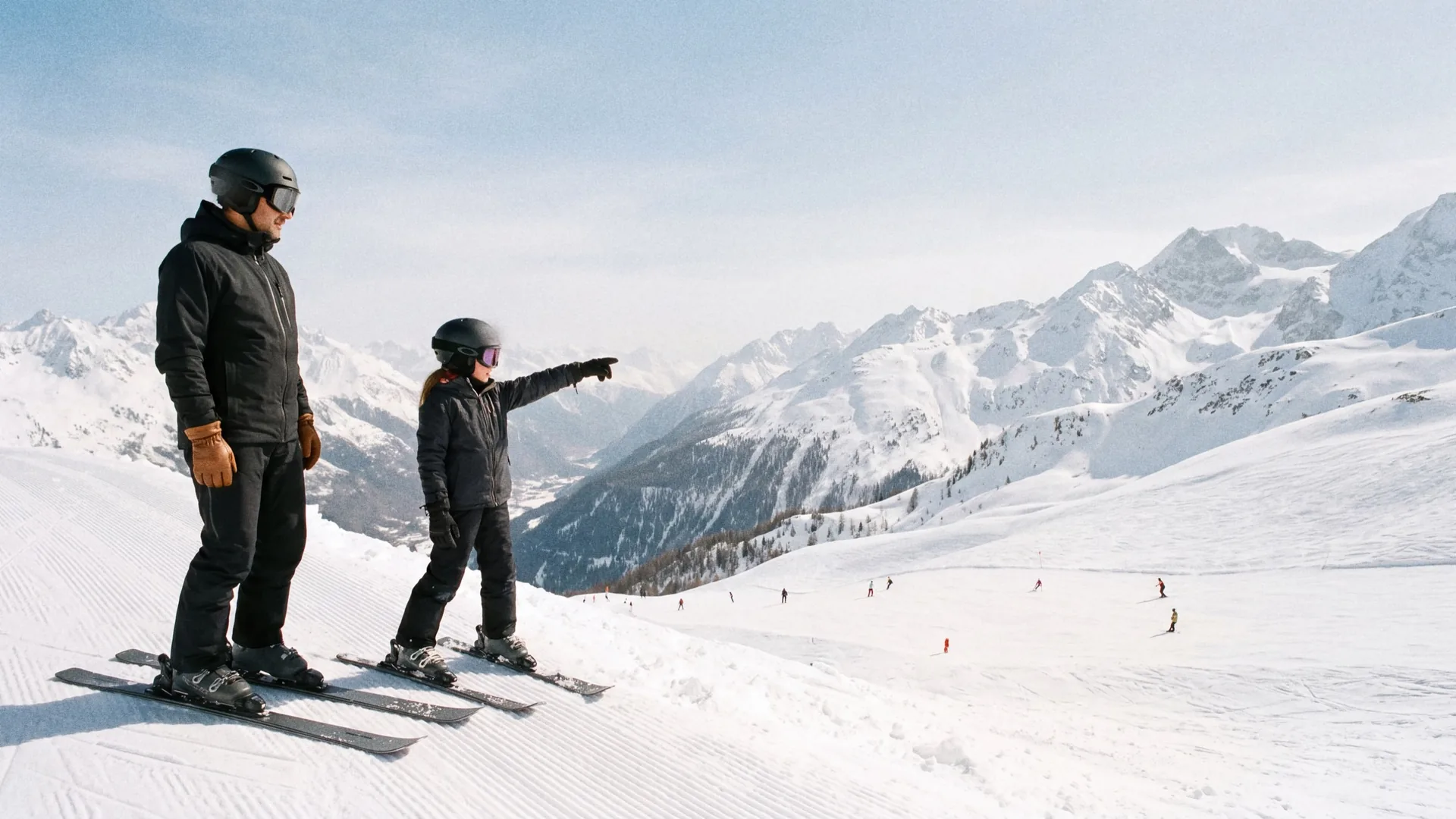
Solid, saturated colours look best against snow: red, cobalt blue, emerald green, mustard yellow, burgundy or a strong orange. They separate the skier from the white slope and still read clearly in a wide shot where a person is small in the frame.
- White and very pale grey disappear into the snow. They can look elegant in a close portrait but get lost in landscape shots.
- All black is smart in the village but turns into a dark shape on a bright slope, with little detail in the fabric.
- Neon can reflect colour onto faces and dominate every frame. Use it in small touches rather than head to toe.
- Busy patterns compete with the scenery. A plain jacket with patterned accessories is easier on the eye.
- Large logos date photos and pull attention away from faces. Small or tonal branding is better.
One practical test: stand at the window of your chalet on a sunny morning and look at the outfit against the snow outside. If you can describe it in one or two colours, it will photograph well.
Should a family wear matching ski outfits for photos?
Coordinate rather than match. Identical jackets make a family look like a ski school group, and in action shots it becomes hard to tell who is who. A shared palette works better.
- Pick two or three colours for the whole family, for example navy, red and cream, and give each person one strong piece.
- Give children the brightest colours. They are the easiest to spot on a slope, in photos and in real life.
- Keep trousers neutral (navy, charcoal, black or white) so jackets do the work.
- Align accessories. Matching hats or neck warmers in the same colour are an easy way to tie a group together without full uniforms.
If you are planning a family session, our guide to ski photoshoot ideas suggests shots and timing that suit children.
What should you wear after skiing and for dinner in the resort?
Warm, comfortable layers and boots with grip. After skiing you will often walk on packed snow or icy paths between your chalet or hotel, the slopes and the restaurants, so footwear matters more than in a city. Courchevel Tourism lists snow boots, gloves and warm clothing among the things to pack for a winter stay.
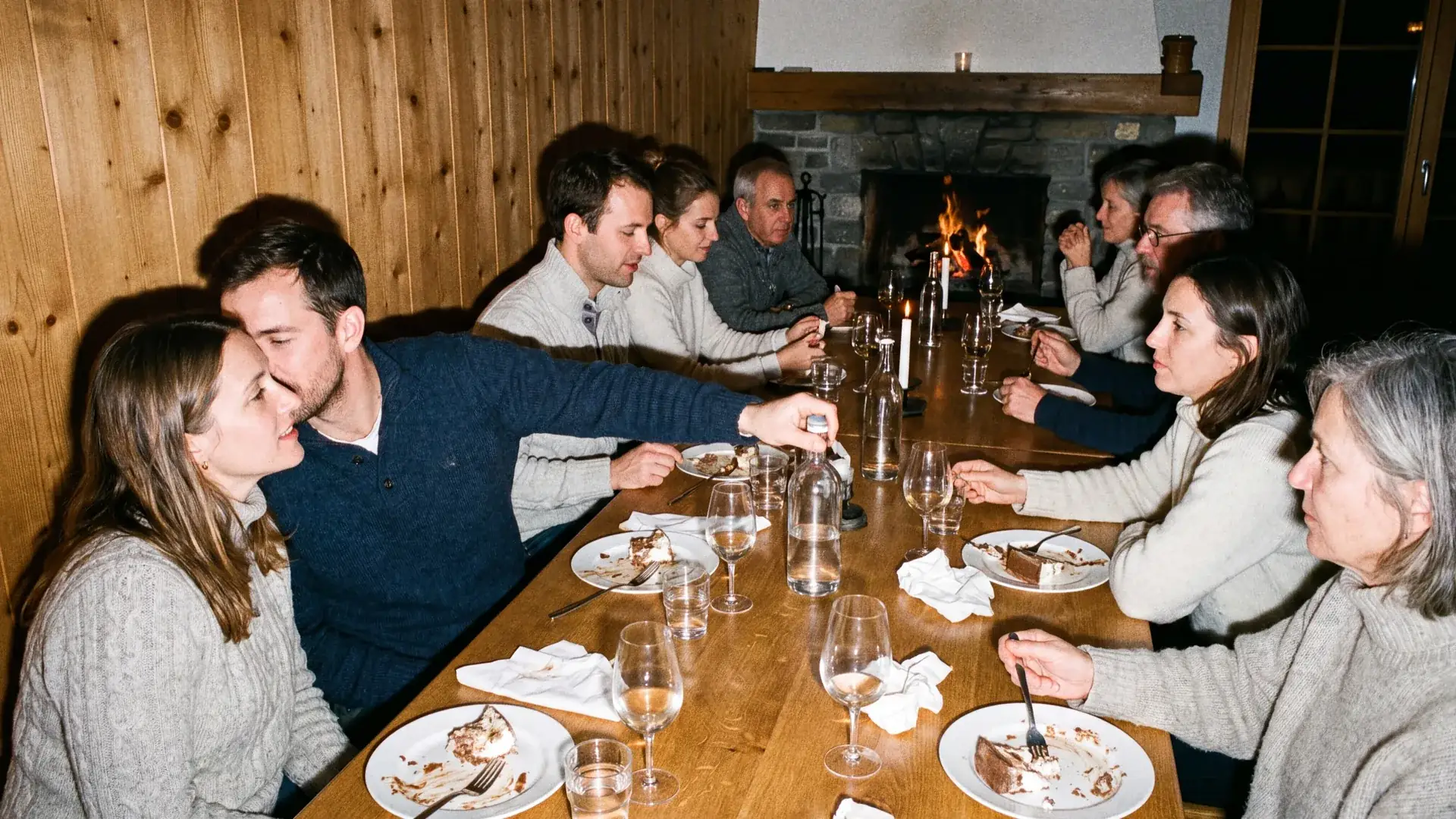
For photos at the chalet or at dinner, textured knitwear, wool and shearling photograph well in warm indoor light. Avoid very shiny synthetic fabrics, which reflect flash and lamps. If you are heading out for dinner, our guide to Courchevel restaurants covers where to book.
Want photos that show the outfits properly?
Riva Photography Courchevel connects visitors with private photographers who ski, so the whole group, including the person who usually holds the phone, appears in the pictures. Sessions start at one hour (30 photos, 590 € including VAT), and for sessions on the slopes the photographer's lift pass is added to the quote at the public price. Write to us on WhatsApp with your dates and group size through the contact section, and we will suggest a time of day and a format.
Frequently asked questions
What should you wear under ski trousers?
A base layer of leggings in merino wool or a synthetic fabric, and one pair of ski-specific socks. Avoid cotton, which ski schools such as Oxyski advise against for base layers.
How cold is it in Courchevel in January?
Météo-France does not publish a climate sheet for Courchevel itself. At the Val d'Isère station, at the same 1,850 m altitude in the Tarentaise, the 1991-2020 average January high is -0.4 °C and the average low -8.9 °C.
What colours are best for ski photos?
Solid, saturated colours such as red, cobalt blue, green, mustard or burgundy. They stand out against snow. White disappears into the background and all black loses detail on a bright slope.
Should families wear matching ski outfits?
It is better to coordinate than to match. Choose a palette of two or three colours, give each person one strong piece and keep trousers neutral so everyone is still recognisable in action shots.
Do you need sun cream when skiing in winter?
Yes. The World Health Organization notes that UV levels increase by about 10 per cent with every 1,000 m of altitude and that fresh snow almost doubles a person's UV exposure.
Planning a session in Courchevel?
Send us your dates and where you are staying. We reply on WhatsApp within the hour with an available photographer and a quote.
Message us on WhatsAppBook a photographer in Courchevel
Sources
Facts, times and rules in this guide come from these sources, checked in October 2026.
- Météo-France, climate statistics 1991-2020, Val d'Isère station (1,850 m), checked October 2026.
- Météo-France, climate statistics 1991-2020, Saint-Martin-de-Belleville station (1,443 m), checked October 2026.
- Courchevel Tourism, When to go skiing?, checked October 2026.
- Courchevel Tourism, Ski holidays in Courchevel (what to pack), checked October 2026.
- Oxyski ski school, First day at ski school, checked October 2026.
- World Health Organization, Radiation: ultraviolet (UV) radiation, checked October 2026.